
Coatings
Polyurea Floor Coatings in St. Charles & Greater St. Louis
Polyurea is a two-component, rapid-cure resin that bonds to concrete at pressures exceeding 400 psi and stretches with the slab, rather than fighting against it. Elephant Floor Solutions builds several systems on that chemistry for garages, basements, lobbies, offices, and commercial spaces across St. Charles County and the Greater St. Louis area — a standard chip broadcast finished in a single day, a moisture-vapor-barrier primer build for slabs pushing vapor from below, and a double-broadcast full-flake system for floors that need maximum thickness and coverage. Every one of them goes down over a diamond-ground slab and seals under a clear polyaspartic topcoat. What they share is the reason polyurea is underneath in the first place: 65% elongation, so the coating travels with concrete that moves through every Missouri freeze and thaw rather than cracking off it.
How the System is Built
Every installation begins with our 26-point inspection — moisture testing, detection of existing sealers and contamination, and full crack and joint mapping — so the system is specified for the slab in front of us rather than assumed. The floor is then diamond-ground to the profile the coating requires for a true mechanical bond, and cracks and spalls are repaired with structural fillers rated for movement. Nothing goes down until the slab tests within the manufacturer's limits for moisture and cure.

You leave in the morning, you come home to a finished floor. The polyurea basecoat goes down first and grips the concrete hard enough that the slab gives before the bond does — then chip is broadcast into it until the color runs wall to wall, and a clear polyaspartic topcoat locks it in with non-skid texture. Four layers, over 50 mils thick, cured and ready the same day it started.


Same floor, one layer deeper. Some slabs push moisture up from underneath — it's invisible, and left alone it will lift a coating off over time. We test for it before we quote, and when the reading calls for it a moisture barrier primer goes down first and everything else builds on top. Five layers instead of four, still finished the same day, and the floor above it is identical to any other we install.
Then the system itself:
Optional pre-step · Moisture vapor barrier primer. Some slabs push moisture up from underneath, and it will lift a coating off over time. Our moisture testing tells us whether yours does — if it does, this goes down first and the rest of the system builds on top of it.
1 · Pigmented polyurea basecoat. Mixed two parts base to one activator and rolled at six to eight mils, tinted to complement the chip blend. This is the layer doing the bonding, and the layer with give in it — concrete moves through a Missouri freeze and thaw, and this moves with it.
2 · Decorative chip broadcast. Quarter-inch chip is thrown into the wet base and kept coming until the resin is completely covered — full refusal, not a scatter. Once it sets enough to walk, the loose flake is scraped back off.
3 · Clear polyaspartic topcoat. Applied over the locked-in broadcast at ten to sixteen mils, sealing the chip and carrying the non-skid texture. It's also the layer that faces the sun — polyurea is a basecoat, never the exposed surface.
Finished thickness runs over 50 mils nominal — a real floor, not a film. Adhesion tests above 400 psi, which is 100% concrete failure: in testing, the slab gives way before the bond does.
Same Resin, Different Day
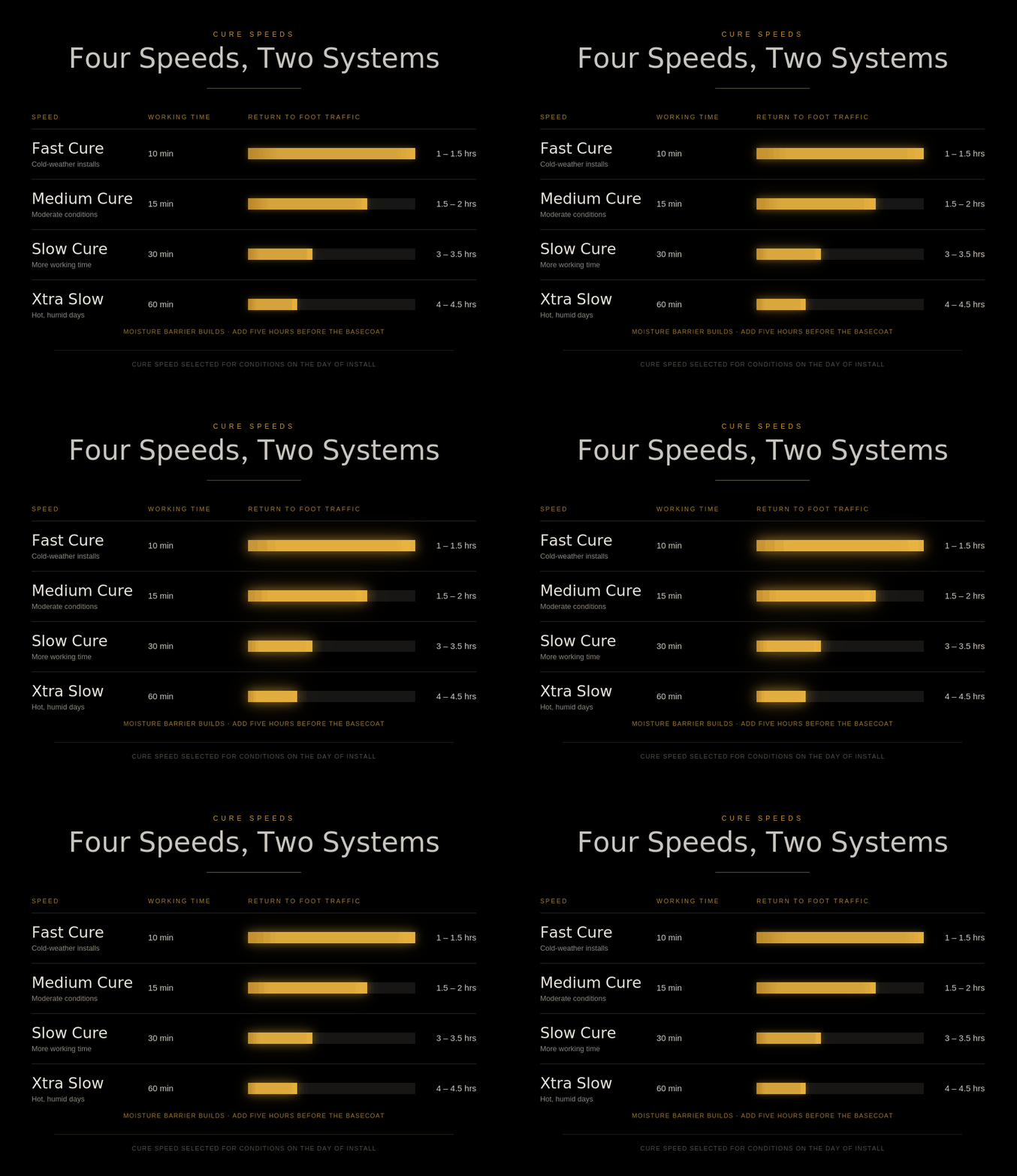
Polyurea is manufactured in four cure speeds. Temperature and the size of the floor decide how much working time we need — the medium and fast speeds are formulated for cold-weather application, and the slower speeds give us room to work a large floor properly in the heat.
Built to Endure
Polyurea does its work underneath, where you'll never see it. It grips the concrete so hard that in testing, the slab breaks before the bond does. And because it stays flexible after it cures, it moves with your floor instead of fighting it — which matters in Missouri, where concrete shifts every time the weather turns. The chip and clear topcoat above it take the daily abuse: hot tires, dropped tools, dragged furniture. Road salt, motor oil, gasoline, brake fluid, bleach, coffee, spilled wine — none of it stains, and it all wipes up. Every floor gets non-skid texture, so it stays sure underfoot when it's wet. This isn't paint on a garage floor. It's a floor that outlasts the reason you called.

Color and Flake
The chip broadcast is what gives the floor its character, and the range is wide. Decorative chip comes in seventeen signature blends and four marble blends (custom blends available), integrally colored so the color runs through the flake rather than sitting on it, and UV stable so it holds up under sunlight. Quarter-inch chip is the standard size and what we install.
The polyurea basecoat underneath is tinted to complement the blend, which changes how the floor reads — the same chip over a light base looks open and bright, over a dark base it looks deeper and heavier. That tinted base does double duty here: chip is broadcast into it until no resin shows through, so what you see is the blend, and the polyurea works out of sight. Blends are chosen during the consultation against your cabinets, trim, and the light in the space, and every floor is finished with non-skid texture.

Where do we install Polyurea?
Polyurea is never the whole floor — it's the layer that makes the rest of it hold. It goes down against the concrete, takes the chip broadcast, and disappears under a clear polyaspartic topcoat. That's not a limitation, it's the design: polyurea grips harder and stays more flexible than what goes over it, so it does the bonding while the polyaspartic handles the sunlight and the wear. Two builds come off that chemistry — the standard system, and the same system over a moisture barrier when the slab calls for it.
That flexibility is why these floors go where the concrete works hardest. In homes: garages that swing forty degrees between a February morning and a July afternoon, basements sitting on grade, workshops, laundry and mud rooms. In business: veterinary clinics, kennels, and boarding runs, where urine and disinfectants both wipe up with nowhere to soak in — plus lobbies and waiting areas, offices, hallways and stairwells, cafeterias, bars and dining rooms, and restrooms. Slabs move. Ours move with them.
Commonly asked Questions
Is polyurea stronger than epoxy?
For a floor that has to move, yes. Polyurea grips harder and stays flexible, so it holds on when concrete shifts through a Missouri winter — epoxy is more rigid and can let go under the same conditions. Epoxy has its place where a floor needs thickness and compressive strength. For a garage or basement slab that swings with the seasons, polyurea is the better bond.
Is polyurea the same as polyaspartic?
They're relatives, not twins. Polyaspartic is a type of polyurea formulated to stay clear in sunlight, which is why it's the topcoat. Polyurea does the bonding underneath. That's how the system is engineered — each layer doing what it's built for.
How long does a polyurea floor last?
Decades, when the prep is done right. The bond tests stronger than the concrete under it, the chip and topcoat carry the wear, and the polyurea flexes instead of cracking. That all rests on the slab being ground to profile and tested before any resin gets opened — which is why we spend as much time on preparation as we do on the coating.
Can it be installed in winter?
Yes. Polyurea comes in four cure speeds, and the faster ones are formulated for cold-weather work. We match the speed to the conditions on the day and install year-round.
How long does it take?
Most floors go down in a single day. We arrive in the morning, prep the slab, and by the time we leave the floor is installed — you'll be walking on it that evening and parking on it in a couple of days. If your slab needs a moisture barrier, that adds a few hours to the same day.